
The Teochew Store Blog / food
Teochew Language Exhibition at Hougang Mall
Understanding Teochew Birthday Customs 潮州生日习俗简说

对于潮州人而言,生日承载着深厚的意义。在历经天灾、饥荒与动荡的往复后,祖先们形成了一种谨慎庆祝生命的智慧——既隆重敬祝长寿,亦克制常日庆生,由此积淀出独特而丰厚的礼俗传统。
Singapore Teochew Dragon Boat Festival 2025
We have 10,000 fans on YouTube!
We don't mention this enough. The Teochew Store has our own YouTube channel (with 10,000 fans now!), with a number of curated playlists with videos for Teochew language lessons, trendy music, films, documentary, culture, opera and children too!
Youtube.com/@theteochewstore
The Story Behind The Teochew Store
We thanks Ethos Diary, an inspiring student-led project from Singapore, for this interview with our The Teochew Store co-founder, Jason.
Mid-Autumn Festival Celebrations at the Singapore Teo Ann Huay Kuan 潮安會館
Mid-Autumn Festival Celebrations at the Singapore Teo Ann Huay Kuan 潮安會館. A night when families and traditions came alive for the young and the not-so-old ❤️❤️
Tan Wanxuan:Documenting Images to showcase diverse Teochew cultures

In recent months, a series of short videos about overseas Teochews have gone viral on Douyin (TikTok), Facebook and other popular social media platforms, and captured the attention of Teochew communities in China and abroad. The videos originate from the official accounts of the Teochew cuisine documentary, “Flavours of Teochew from the Four Seas” (四海潮味, unofficial English translation). Featuring humorous and touching live stories of Teochew people living in Thailand, Vietnam, Malaysia, Indonesia and France, the clips take on a refreshing perspective to present the blending of the Teochew identity with a diversity of local cultures.
Tan Wanxuan (陳婉璇), who hails from Teo-ann (潮安) district in Teochew, China, is the external liaison and producer of this documentary, as well as the director and editor of these short videos. Using Teochew food as a medium, “Flavours of Teochew from the Four Seas” describes the culture, customs and emotional longing for home of Teochew people from different corners of the world. How did Wanxuan become part of this documentary? What has she gained from her travels to these countries to interview and document about our Teochew cuisine and people? The Teochew Store was in touch with Wanxuan to learn about her story and “Flavours of Teochew from the Four Seas”.
专访|陈婉璇:用纪实影像展示多样潮文化

近期,有一组关于海外潮州人的短视频在抖音、Facebook等社交媒体上迅速走红,引起了海外及中国潮州社群的热烈关注。这组视频来自潮菜纪录片《四海潮味》的官方账号,视频中泰国、越南、马来西亚、印尼、法国等地潮州人或幽默、或感人的生活片段,从崭新的视角呈现了各地潮州人与当地多元文化的融合。
来自中国潮安的陈婉璇是这部纪录片的外联与制片,也是这组短视频的编导与剪辑师。《四海潮味》以潮州美食为媒介,描绘了各地潮州人的文化风俗、家常情感。婉璇是如何与这部纪录片结缘?在奔赴各国采访、记录潮州菜和潮州人的过程中,她有哪些收获?潮舗近期连线婉璇,请她讲讲她与《四海潮味》的故事。
Teochew through the eyes of its visitors: A Spanish Jesuit shipwrecked in Teochew (Part 1)
Three words that strike fear in every Teochew child: pah ka-ceng 拍尻倉!
Did you know that this was once also a punishment meted out to adults in China? A Jesuit Father, Adriano de las Cortes, learned this shuddering fact, and more, when a shipwreck made him an accidental visitor to the Teochew region 400 years ago.

Recipe for making Soon Kueh using winter bamboo shoots
Here is a recipe from Singapore for making Soon Kueh using winter bamboo shoots (dang soon 冬笋)
Courtesy of Mr Tan Peng Boon.
Follow The Teochew Store on Telegram/ 欢迎订阅潮舗的Telegram频道,获得最新资讯: https://t.me/theteochewstore
Recipe for making Ku Chai (chives) Kueh
Here is a recipe from Singapore for making Ku Chai (chives) Kueh.
Courtesy of Mr Tan Peng Boon.
Follow The Teochew Store on Telegram/ 欢迎订阅潮铺的Telegram频道,获得最新资讯: https://t.me/theteochewstore
Recipe for making Ko-le (cabbage) Kueh
Here is a recipe from Singapore for making Ko-le (Cabbage) Kueh.
Courtesy of Mr Tan Peng Boon.
Follow The Teochew Store on Telegram/ 欢迎订阅潮铺的Telegram频道,获得最新资讯: https://t.me/theteochewstore
Teochew through the eyes of its visitors: Han Yu, the genius who discovered one of life's greatest joys

Have you ever wondered how did our forefathers live 100 years ago, 200 years ago, or even 1,000 years ago?
Our ancestors were a lot of things. Merchants, traders, seafarers, fishermen, agriculturalists, tea connoisseurs, culinary experts, artisans, builders, artists, musicians, poets, etc. But somehow there was not a historian among them. They spent their lives and energies in pursuit of happiness in many ways that today endow us with a rich cultural heritage and identity. Yet, it did not occur to them to document themselves or the world they lived in.
Fortunately, the Teochew region had over the centuries its fair share of visitors, of whom a few were both keen observers and skilled writers.
We begin a new series of articles telling the history and people of Teochew through the eyes of these men and women, with Han Yu (韓愈), a literary genius from the Tang dynasty, who came to Teochew more than 1000 years ago and not only escaped death here, but also discovered here one of the life's greatest joys.
A Recipe for making Deluxe Png Kueh
Here is a recipe from Singapore for making a deluxe version of our Teochew Png Kueh. Compared to png kueh commonly sold in the market, it uses quality and a generous amount of ingredients. Commentary in the video is in English.
Courtesy of Mr Tan Peng Boon.
Follow The Teochew Store on Telegram/ 欢迎订阅潮铺的Telegram频道,获得最新资讯: https://t.me/theteochewstore
The Teochew Community in 1997 Hong Kong
1990s Hong Kong is best remembered as a wealthy financial hub and the centre of the Chinese film industry. People often overlooked that pre-1997 Hong Kong was also, after Thailand, home to the world's second largest Teochew diaspora that numbered about 1.2 million. Just how large was the contribution of the Teochew people's contribution to Hong Kong's prosperity?
二十世紀九十年代的香港是著名富裕的金融城市和華人電影業中心。許多人不知道,其實1997年以前的香港,還是世界第二大的潮籍僑民定居地,僅次於泰國。在香港97年的人口總數中,潮州移民就有將近一百二十萬。潮州人對香港的繁榮,貢獻究竟有多少?請觀看紀錄片《潮人》之香江處處聞潮聲。
Teochew animation film: Persimmon Tree 潮語動畫片:《柿子樹》
因為我們是她永遠疼愛的孩子。祝天下每一位媽媽,母親節日快樂!
The Teochew Store recommends: An Introduction to the History and Culture of the Teochews in Singapore

An Introduction to the History and Culture of the Teochews in Singapore - a rare English language book on Teochew culture. Available for purchase on Amazon.
"Penned in three sections covering a wide range of topics from history and architecture to customs and the performing arts, the 164-page book published by World Scientific is one of the few of its kind in English." - The Straits Times
A review of the book can be read here.
Teochew Movie "Proud of Me" Theme Song: "Father Have You Eaten?" 潮州電影《爸,我一定行的》主题曲: 老父您食未
Teochew Short Film 潮语微电影: Love in Teoswa 《缘来潮汕》
Watch TV or listen to radio from Teochew on your smartphone? - Now You Can (Part 2)
 Continuing from our earlier introduction of the 汕头橄榄台 app by Shantou Radio and Television Station (STRTV), we review this week the 红桃粿 app byChaozhou Broadcast Television (CZBTV, 潮州广播电视台).
Watch TV or listen to radio from Teochew on your smartphone? - Now You Can (Part 1)
 汕头橄榄台 is an app produced by the Shantou Radio and Television Station (STRTV, 汕头市广播电视台). It serves as a platform to access local news on official announcements, current affairs, food and other activities. Both iOS and Android versions of this app can be downloaded for free from its official site
Teochew Documentary: Town, Country & Seaside Life Round about Swatow, Chaochowfu and Swabue (1935)
This is Life in Shantou - Their New Year Wish is Paying Off Debt

No storefront, but only a handcart, two gas cylinders, eight wooden tables and some plastic chairs. That’s all they have to earn a living.
The owner of all these “treasures” is an old couple, 60-year-old Chen Shilong, and his 56-year-old wife Zheng Zhu. They sell rice noodles at a road intersection, opposite the Zhongshan Park in Jinping District in Shantou.
The couple came to Shantou with their children 20 years ago from the countryside of Jieyang...
Making the Swatow famous Lao Ma Keng Rice-Dumplings 老妈宫粽球做法
The traditional Teochew rice dumpling is called the zanggiu ("dumpling ball"). It is unique as it comes in three types of taste: salty, sweet and sangpeng, that is a combination of both salty and sweet.
In Swatow there is a stall that has been selling its rice dumplings since the 1920s. Known as the Lao Ma Geng Zanggiu, after a nearby old temple, the stall is a household-name in Swatow. This week we bring to you a video showing how its rice-dumplings are made (read more for steps and list of ingredients)
Teochew Short Film 潮语微电影: My Little Devil in Chaozhou 《缘来潮州》
Recipe For Teochew Jellied Pork Skin 美食达人分享:美容养颜的潮州肉皮冻
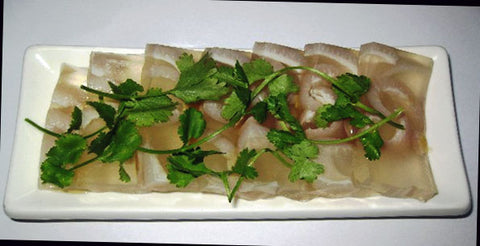
An authentic Teochew dish that is rice in collagen – jellied pork skin. It is inexpensive and highly suited for the dry autumn-winter spell.
一道富含胶原质的潮州菜 — 潮州肉皮冻。经济实惠,最适合在干燥的秋冬季节食用。
Recipe To Make Your Own Teochew-style Mooncake

As the mid-Autumn festival approaches, The Teochew Store has invited Tan Pia Hua 陈冰桦, a food lover and blogger from Teochew, to share her original recipe to make your own special taste Teochew-style mooncake.
美食达人分享:如何自制潮式月饼

潮式月饼又称潮式朥饼,朥字,潮州话指猪油。用猪油掺面粉作皮包甜馅烤焙熟的饼便是朥饼。朥饼终年应市,以中秋节上市为最合时。
一年一度的中秋佳节又要来临,The Teochew Store 潮舖 特别邀请了潮汕资深美食达人陈冰桦,教大家如何自制潮式月饼。
潮州人過年文化 Teochew Chinese New Year Customs
We Are What We Eat – what our favourite plate of Teochew or-luak tells us about our history
The great joy of being a Teochew is the buffet of delicious food that we get to eat. Teochew plain porridge served with pickled vegetable, chai-poh eggs etc etc, char kway teow, braised goose (or duck), steam promfret, pork trotter jelly, all kinds of kuehs… our taste buds are spoilt for choice.

A popular dish for Teochews both in Swatow and overseas is the traditional Teochew oyster omelette or-luak 蠔烙 (literally “pan-fried oysters”). It is simple to prepare, delightful to eat, and certainly needs no introduction. But well, here is anyway a video about a famous or-luak stall in Swatow with 50 years of history:
For anyone inspired to try to serve up a plate yourself, here’s the recipe from allreceipes-Asia :
Ingredients Serves: 4
-
4 eggs
-
2 teaspoons fish or soya sauce
-
2 tablespoons tapioca flour
-
1 tablespoon rice flour
-
2 tablespoons vegetable oil
-
2 cloves garlic, chopped
-
1 teaspoon chilli paste
-
6 to 8 large fresh oysters
-
salt and pepper
-
coriander sprigs
Directions
Prep:10min › Cook:15min › Ready in:25min
-
In a medium bowl, beat the eggs with fish sauce and set aside.
-
Mix the tapioca flour, rice flour and a pinch of salt in 125ml water to make a very thin batter. In a large wok, heat 1 teaspoon oil until smoking hot. Pour in the batter and let it set.
-
Pour the eggs over and when it is almost set, mix everything together. Make a well in the centre by pushing the egg and batter mixture to the sides of the wok. Add the remaining oil and stir in the garlic until fragrant. Add the chilli paste and oysters. Season with salt and pepper to taste. Toss until heated through.
-
Turn onto a serving platter and garnish with coriander sprigs. Serve with bottled chilli sauce mixed with vinegar to taste.
Variations of the or-luak are found in neighbouring southern Fujian (where the Hokkien people live), and the dish is a symbol of the importance of the sea to the lives of the Teochew and Hokkien populations in coastal Southeast China. When the renowned Confucius scholar Han Yu was banished in the 9th century from the Chinese Central Plain by the emperor to become governor of Teochew (at that time a frontier region of the Tang empire), he discovered the Teochew diet of oysters and other exotic seafood and was so fascinated that he composed the poem “Helpful Verses for Yuan Shiba Introducing Food in the South” 《初南食貽元十八協律》to inform his friend Yuan Shiba about them. In what was the prolific poet’s first and only poem with food as the subject, he noted how the Teochews enjoyed food prepared with salty and sour condiments, and dipped in pepper salt, pepper oil and orange sauce (but made him burst into sweat and turned his face red), and confessed that apart from the snake, everything they ate were new to him. For the Teochew people however, the appearance of oysters in our diet traces back even much further.
One day in the late 1950s, an archaeological team from the Guangdong Administrative Committee for Cultural Heritage made an unexpected finding when they chanced upon a shell mound in the remote village of Chenqiao (陳橋), some two kilometres west of Teochew city. Composed of tens of thousands of marine shells, including oyster and clam, it stood at a fairly remarkable height of 1.4 metres. The villagers did not think much of the derelict heap, but for the trained archaeologists this was a treasure trove. Found in many parts of the world near coastlines, lagoons, tidewater flats, rivers and streams, shell middens are not random formations but cultural deposits created by our human forefathers during their transition from the hunter-gathering to sedentary lifestyle 4,000 to 10,000 years ago. As they adapted to living in more confined spaces, their diet was diversified to encompass all everything edible within reach, and shellfish that can be easily collected from shallow waters became an important food source.
And right on cue, investigations at the Chenqiao site unearthed more skeletal remains of cow, pig, deer, fish and turtle (i.e. prehistoric dinner leftovers), and a range of man-made stone and bone tools such as adzes, hatchets, choppers, hammers, pries (for opening the oyster shells) and pottery shards. Even more exciting was the discovery of the fossilised remains of ten human beings, dubbed later by local archaeologists as the “Chenqiao people”. Unfortunately little information has been published about them. Apart from the estimation of their age to be 5,500 and 6,000 years old, it is also reported they included male and female, and young and old, suggesting they were members of a family.
So the next time when you pick up a pair of chopsticks to eat a plate of or-luak, know that you are not indulging in good food, but also continuing a tradition, the Teochew family tradition.
"Like" our Facebook page to stay updated with The Teochew Store.